
Guide to Conductive Hearing Loss: Causes, Signs, Diagnosis and Treatment Methods
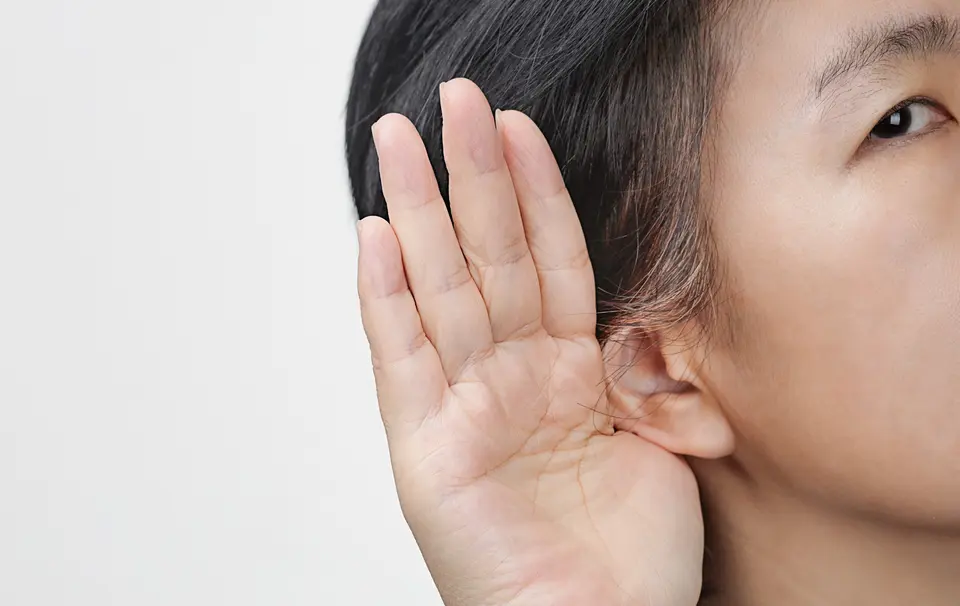
Conductive hearing loss occurs when the transmission of sound waves is obstructed in the outer or middle ear to the inner ear. This can cause sounds and speech to seem muffled.
This article will explore the topic of conductive hearing loss, from the causes to the symptoms, diagnosis and treatment of the condition. It will also cover frequently asked questions about this type of hearing loss.
Causes of Conductive Hearing Loss
Problems with the outer or middle ear can result in conductive hearing loss. Here are some of the common causes:
Issues affecting the outer ear
- Earwax buildup
While our ears typically clean out earwax on their own, there are instances where earwax may build up in the ear canal due to the small ear canal size and/or excessive earwax secretion. This build-up of earwax can block the transmission of sound waves into the ear, resulting in temporary hearing loss.
- Swimmer’s ear (otitis externa)
Often caused by bacterial or fungal infection, swimmer’s ear, also known as otitis externa, is an infection of the external ear canal. It can result in earaches, ear discharge and temporary hearing loss.
- Foreign objects in the ear canal
Foreign objects, such as toys, bugs and cotton swabs, can become lodged in the ear canal by accident. When this happens, the ear canal becomes blocked, leading to the loss of hearing.
- Birth deformities
Some individuals may be born with structural abnormalities in the external ear canal, partially or fully occluding the ear canal. The extent of occlusion would result in different degrees of conductive hearing loss.
- Surfer’s ear (exostoses)
Exostoses are non-cancerous bony growths in the external ear canal often resulting from regular exposure to cold water. These growths can cause blockages in the ear canal if left untreated, leading to hearing loss.
Issues affecting the middle ear
- Middle ear infection (otitis media)
The eustachian tube, which connects the middle ear and the nose, allows fluid to drain from the middle ear. When the mucosal lining of the tube becomes swollen or fails to open or close properly, fluid can backflow from the nasal cavity, build up and get trapped in the middle ear. Bacteria may thrive in this fluid, causing an infection known as otitis media. The infection can result in a fever, earache and hearing loss.
- Damage to the middle ear bones
Benign tumours, such as cholesteatoma or glomus tumours, can grow in the middle ear. Such mass can disrupt the ossicular chain, which is responsible for sound transmission, by puncturing the eardrum, displacing the middle ear bones and/or eroding the bones.
Aside from tumours, ossification or hardening of the middle ear bones can also reduce the effectiveness of sound transmission through these bones. These conditions can subsequently result in conductive hearing loss.
- Perforated eardrum
Physical trauma, ear infections, or severe eustachian tube dysfunction can cause eardrums to be retracted or perforated, depending on the severity. This hole or tear in the eardrum may or may not recover on its own but it can disrupt the normal transmission of sound waves within the ear as long as the perforation persists, causing hearing loss.
Signs of Conductive Hearing Loss
Some common symptoms associated with this type of hearing loss include:
- Sudden or gradual loss of hearing
- Muffled hearing, “water sounds” in the ear or hearing sounds as though underwater
- Fullness in the ear
- Earache
- Dizziness
- Ear discharge
Diagnosing Conductive Hearing Loss
In addition to understanding your signs and symptoms, diagnosing conductive hearing loss involves a combination of the following tests.
Physical ear examination
A physical examination of your ear will be carried out by your hearing care professional. They’ll use an otoscope or microscope to examine your ear canal and eardrum.
Hearing tests
A hearing test may be recommended by your hearing care professional to determine the type and severity of your hearing loss. The hearing test will evaluate your response to sounds of varying loudness, tones and pitches.
Tympanometry
A tympanometry test is used to assess the function of your middle ear. It measures the reaction of your eardrum to changes in air pressure within the ear canal. Using the test results, your hearing care provider can identify problems in the middle ear that may be responsible for your hearing loss, such as middle ear fluid, otosclerosis and ossicular chain discontinuity.
Imaging tests
A computed tomography (CT) scan or magnetic resonance imaging (MRI) may be used by your hearing care provider to get a clearer picture of the inside of your ear. These imaging tests are particularly helpful when diagnosing damage or tumours in the ear.
Treatment for Conductive Hearing Loss
Less severe cases of conductive hearing loss can often resolve naturally within a couple of days. However, more severe cases may require treatment through methods such as hearing aids, medication or surgery.
Medication
Conductive hearing loss resulting from ear infections may be treated with topical antibiotics or anti-fungal medications.
Surgery
Surgery is another option for treating conductive hearing loss, and the type of surgery will depend on the cause of the condition. Restorative surgeries can be done to repair a tear in the eardrum and replace eroded or damaged middle ear bones.
On the other hand, chronic accumulation of middle ear fluid might require tympanostomy. This procedure will facilitate fluid drainage and prevent excessive fluid and pressure buildup in the middle ear, which may result in eardrum perforation.
Hearing aids
Even though most conductive hearing loss can be treated medically, not all treatments will restore the full hearing ability and some conditions may have a chance of recurrence. After obtaining medical clearance for the respective ear conditions, hearing aids can be considered as a viable hearing loss treatment option.
These devices serve to capture and amplify sounds to a level sufficient to overcome the “obstruction/discontinuity” in the sound transmission pathway present in conductive hearing loss.
Hearing aids come in various styles and sizes to suit your unique lifestyle needs and preferences. From tiny completely-in-the-canal (CIC) hearing aids to powerful traditional behind-the-ear (BTE) hearing aids to bone-anchored hearing systems, each type of device is designed with different features and capabilities.
For ears that remain dry and have a low risk of infections, there are no restrictions to the type of hearing aid that one can wear. However, for ear conditions that cause recurrent ear discharge and fluctuating hearing levels, BTE hearing aids and bone-anchored hearing systems are more suitable than other types as these devices are less prone to damage from moisture.
BTE hearing aids and bone-anchored hearing systems differ in the way they deliver sounds to our inner ears – the former via the ear canal just like how we hear sounds normally while the latter sends vibrations through the bone behind the ear. As a result, bone-anchored hearing systems usually sound clearer than BTE hearing aids as there is less energy lost in the sound transmission process.
However, to obtain optimum results, the bone-anchored hearing system requires minor surgery to implant an abutment to the bone behind the ear for better sound transmission. Speak to your hearing care professional to find out more and discuss the solutions suitable for your condition.
FAQs About Conductive Hearing Loss
While sensorineural hearing loss involves problems with the inner ear or auditory nerve pathways leading to the brain, conductive hearing loss involves problems with the middle or outer ear. Additionally, sensorineural hearing loss is often permanent, whereas conductive hearing loss can be temporary or permanent.
This article was originally published on Soup.io.

In her years of clinical practice, Jennifer has always adopted a patient-centric approach — empathising with patients’ problems, setting realistic expectations and delivering effective management tips.
As the Team Lead, Jennifer oversees the professional development and ensures good service quality in the team.
Jennifer Lee
Senior Clinical Audiologist
Schedule a Free Hearing Test
Required fields are marked.
*Hearing Partners does not offer ear wax removal services.