
Understanding Benign Paroxysmal Positional Vertigo (BPPV): Symptoms, Causes and Treatment
Benign Paroxysmal Positional Vertigo (BPPV) occurs when tiny crystals in the inner ear become dislodged and either float freely in the vestibular system or get stuck in the sensors that detect movement. BPPV typically sets in within seconds to minutes after a change in position, as gravity causes the crystals to shift. The resulting vertigo lasts as long as the crystals remain in motion, which can range from minutes to hours.
BPPV can affect individuals of all ages but is most frequently seen in those over 60, as noted by Jennifer Lee, Senior Clinical Audiologist at Hearing Partners. It’s also found to be more common in women than in men, according to a study in which 50% more women than men experienced BPPV. While the condition isn’t life-threatening, its symptoms can be distressing and interfere with daily activities.
This article will explore the causes and risk factors of BPPV, its common symptoms, and how it is diagnosed. It will also discuss the risks of leaving BPPV untreated and some effective treatment options to help manage the condition and reduce the frequency of vertigo episodes.
Symptoms of BPPV
Episodes of BPPV symptoms are usually brief, often lasting less than a minute. Symptoms are typically triggered by sudden head movements or even when standing and walking. The primary symptoms of BPPV include:
- Sudden, brief periods of vertigo lasting less than a minute
- Constant lightheadedness / floating sensation
These symptoms are typically triggered or worsened by activities such as:
- Turning over in bed
- Getting in or out of bed
- Tilting the head back or forward
- Bending over
Note!
Unlike conditions such as Ménière’s disease or labyrinthitis, BPPV does not cause hearing loss, tinnitus, or a feeling of pressure in the ears. It is strictly a balance disorder related to the inner ear.
Causes of BPPV
The utricle of the vestibular system uses the weight of calcium carbonate crystals called otoconia to detect linear head movements. When these crystals become dislodged and enter the semicircular canals, they interfere with normal signals to the brain, causing vertigo.
Often, there is no identifiable cause for BPPV. This is referred to as idiopathic BPPV. However, when a cause is known, it’s frequently linked to a head injury, ranging from a minor knock to a more severe trauma.
Other causes include:
- Inner ear infection
- Ear surgery
- Aging
- Vitamin D deficiency
- Hormonal fluctuations
Take our dizziness evaluation quiz!
If you suspect you have BPPV, take our dizziness evaluation quiz to determine whether you need to see our audiologist.
How to Diagnose BPPV
Diagnosing BPPV begins with a detailed medical history and physical examination. A doctor or audiologist will ask about the nature of the dizziness, what triggers it, and how long it lasts.
The Dix-Hallpike manoeuvre is commonly used to confirm BPPV via observation of the key diagnostic sign of nystagmus, an involuntary jerking of the eyes. The individual’s head is turned 45 degrees while sitting, then quickly reclined backwards. If vertigo and nystagmus occur, BPPV is confirmed.
The lateral roll is another manoeuvre that assesses the horizontal semicircular canals. These manoeuvres can be done bedside or with goggles to monitor mild nystagmus.
BPPV Treatment Options
According to Jennifer, handling BPPV requires a targeted, personalised approach, especially for those with overlapping vestibular disorders. They may require a combination of treatment methods to address symptoms fully.
For individuals with BPPV, healthcare professionals may recommend the following treatment options, depending on their unique needs and condition.
Epley maneuver and BBQ Roll
The Epley manoeuvre and BBQ Roll are a series of guided head and body movements designed to reposition the otoconia from the posterior and lateral semicircular canals back into their usual positions, where they no longer cause vertigo. This simple and noninvasive technique, typically performed by a healthcare professional, can provide immediate relief for many individuals.
Following treatment, individuals may need to take precautions to prevent symptoms from returning. These include not sleeping on the side of the affected ear and not leaning too far forward or backward.
Surgery
Surgery is rarely needed and is only considered if repositioning manoeuvres fail to resolve BPPV. The most common procedure is a posterior semicircular canal occlusion, where the affected canal is surgically blocked to prevent the crystals from moving. While this can be effective, there are risks, including potential hearing loss in the operated ear.
TRV Chair for Diagnosing and Treating BPPV
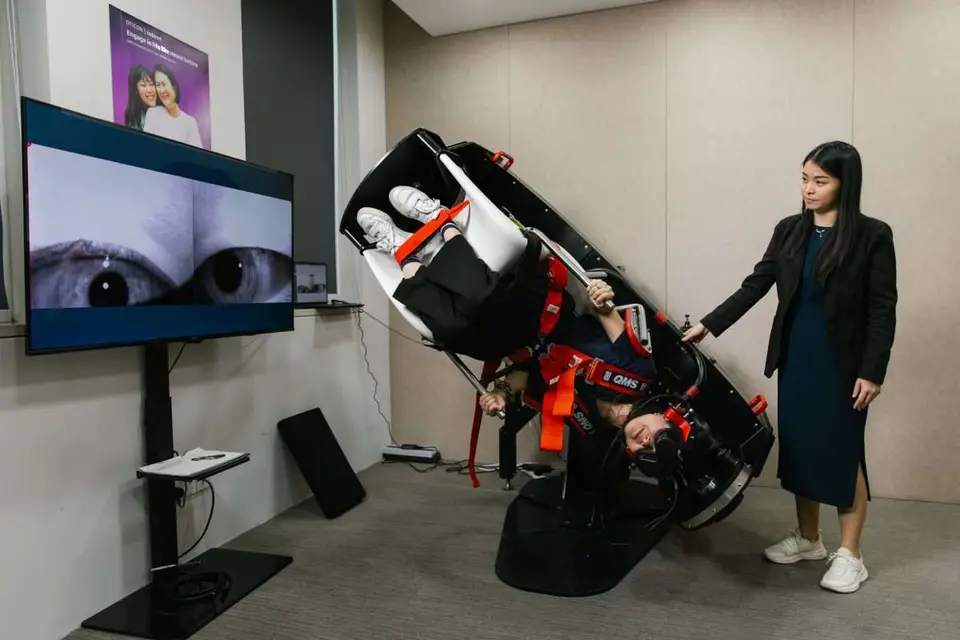
For individuals who do not respond to traditional BPPV treatments or those with multi-canal BPPV, healthcare professionals may recommend a torso-restrained vestibular (TRV) chair. This advanced treatment method combines 360-degree rotation with eye movement tracking technology to identify affected areas and perform targeted repositioning manoeuvres.
The TRV chair’s precision helps reveal subtle eye movement patterns that are difficult to detect during bedside examinations, enabling more accurate diagnoses of complex BPPV cases. Additionally, its smooth, motorised movements and secure positioning provide a more comfortable treatment experience by minimising sudden, jerky motions that can worsen nausea.
The TRV chair can also apply kinetic knocks, which are small, controlled movements, to help dislodged crystals move more efficiently through the inner ear canals, notes Jennifer. By guiding these repositioning movements with greater accuracy, the TRV chair can accelerate symptom relief and improve treatment outcomes.
On average, a treatment session using a TRV chair lasts 30 minutes for diagnosis or 60 minutes if treatment is required.
Who is it suitable for?
In addition to being recommended for individuals who do not respond to traditional treatments (i.e. those experiencing refractory BPPV), this specialised chair is particularly beneficial for elderly patients, those who are overweight, and individuals with neck issues or anxiety.
However, it isn’t suitable for those with a history of brain aneurysms or hemorrhages. Pregnant women and individuals with heart conditions or high blood pressure should also take precautions before undergoing treatment.
TRV chair effectiveness
According to a study published in The Journal of International Advanced Otology, 60% of individuals experience symptom relief after just one treatment with the TRV chair, with an average of two sessions needed to fully resolve their BPPV.
Jennifer shares one such case involving a woman in her late 40s who likely began experiencing symptoms a few weeks before her first TRV chair session. She noticed vertigo while swimming—particularly when turning to breathe, doing backstrokes, or performing backflips. These episodes affected her orientation in the water and diminished her confidence in swimming.
Before seeking treatment, she had not consulted a medical professional or attempted any repositioning manoeuvres. Using the TRV chair, she was diagnosed with right posterior canal BPPV. While she experienced mild vertigo during the treatment, she found it tolerable and was able to move normally afterward.
A follow-up one week later showed significant symptom improvement, and she has not needed further treatment since. She later returned to competitive swimming without issues.
The TRV chair also boasts a 92.4% success rate in treating individuals with refractory BPPV, according to another study.
At Hearing Partners, a man in his mid-70s sought treatment after experiencing recurrent BPPV. He had a history of BPPV before the COVID-19 pandemic and had previously been treated by an ENT specialist using bedside manoeuvres. When his symptoms recurred, he attempted these manoeuvres himself but found no relief.
Through the TRV chair, he was diagnosed with right lateral canal BPPV. Though initially anxious, he tolerated the treatment procedure well, and at his one-week follow-up, he reported complete resolution of his dizziness symptoms.
Get treated for BPPV at Hearing Partners
At Hearing Partners, we offer diagnosis and treatment for BPPV using the TRV chair. Take this quiz to find out if you are suitable for this treatment.
Complications of BPPV and Vertigo
While vertigo and BPPV aren’t usually life-threatening, they can increase your risk of injury and significantly impact your overall well-being. They can result in:
- A higher risk of falls, especially in older adults
- Injuries from falls or accidents during vertigo episodes
- Increased anxiety due to the unpredictable nature of vertigo episodes
- Reduced quality of life due to fear of episodes and activity limitations
If left untreated, vertigo can become chronic or lead to Persistent Postural-Perceptual Dizziness (PPPD), which is more debilitating and difficult to manage. Additionally, vertigo may be a symptom of serious underlying conditions that can cause long-term complications if not addressed, such as:
- Ménière’s disease: If uncontrolled, it can lead to worsening hearing loss, tinnitus, and recurrent vertigo
- Vestibular migraine: Without management, it can cause hypersensitivity to motion, smells, light, and sounds
- Stroke
- Brain tumours
Ultimately, untreated BPPV and vertigo can diminish your quality of life and well-being. Seeking timely diagnosis and treatment from a healthcare professional is essential to managing symptoms and preventing complications.
FAQs About BPPV
No, BPPV is not the same as vertigo, rather, it is a cause of vertigo. Vertigo is a symptom that creates the sensation of spinning, while BPPV is a balance disorder caused by displaced inner ear crystals that trigger episodes of vertigo when the head moves in certain positions.

In her years of clinical practice, Jennifer has always adopted a patient-centric approach — empathising with patients’ problems, setting realistic expectations and delivering effective management tips.
As the Team Lead, Jennifer oversees the professional development and ensures good service quality in the team.
Jennifer Lee
Senior Clinical Audiologist
Schedule a Free Hearing Test
Required fields are marked.
*Hearing Partners does not offer ear wax removal services.